
TPO
- Material
- Thermoplastic polyolefin
- Usual Color
- White
- Seam Method
- Hot-air welded
- Grease
- Moderate resistance
- Cold Flex
- Good
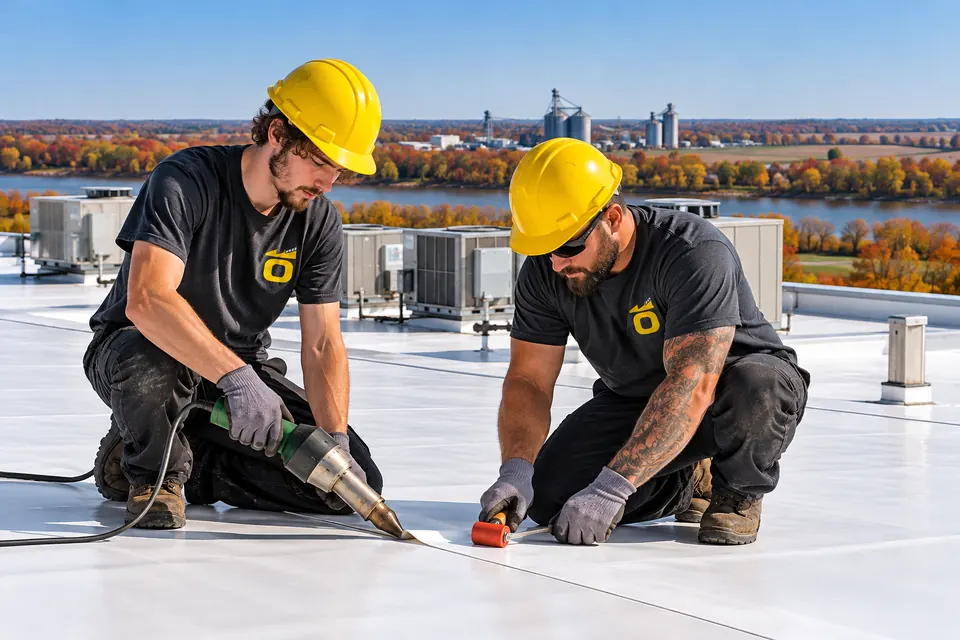
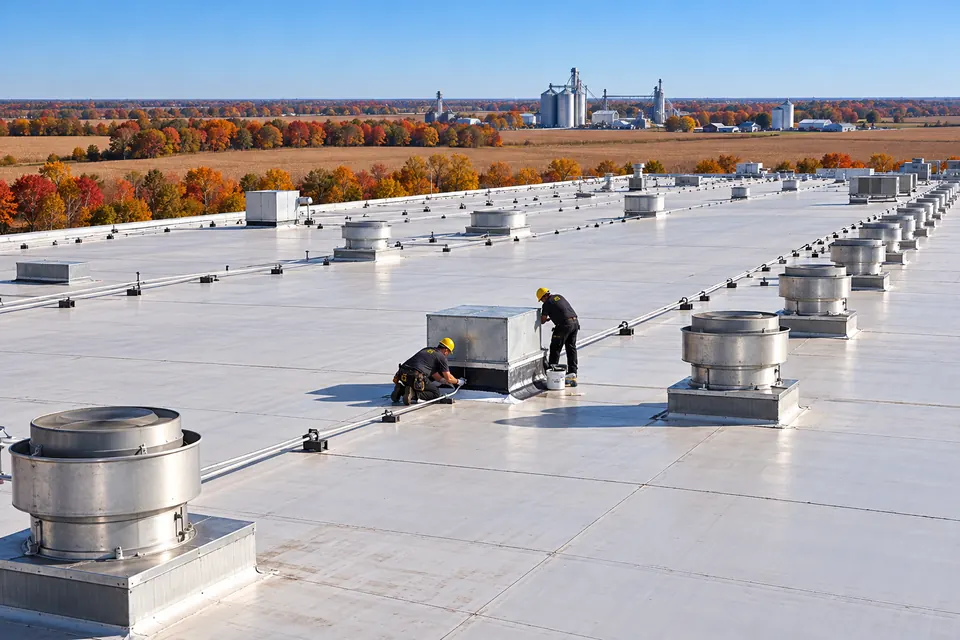
As an Owensboro TPO roofing contractor, we install white thermoplastic membranes with hot-air welded seams on low-slope warehouses, retail centers, offices, and plants.
An Owensboro TPO roofing contractor weighs these two single-ply sheets against the cooling load, grease exposure, and how the seams get made.
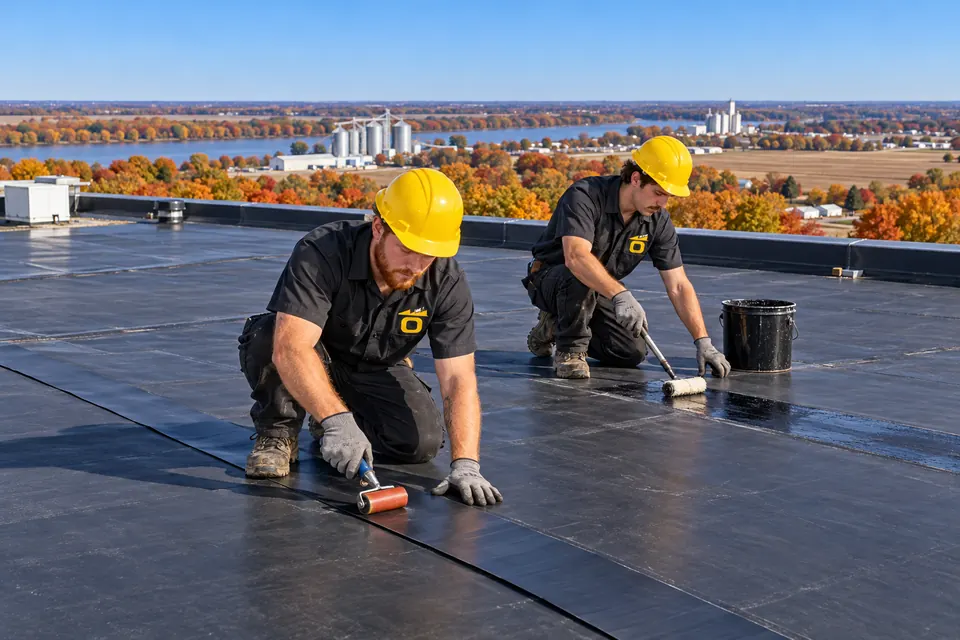
Kitchen exhaust fans dropping grease push the choice toward PVC near the fans; see industrial roofing for plant exposures.
Older TPO roofs fail in a handful of predictable places. These are the ones we look at first.
Missing cover patches or a cold weld left a small channel through the thickest part of the lap.
We probe every T-joint, clean and reweld the lap, and add a cover patch over each one.
Dirt and leaf debris build up on a white sheet and cut its reflectance over the years.
A scheduled washing restores the surface, and walkway pads keep traffic off the field near units.
High winds flutter a mechanically attached membrane until plates wear at the laps.
Worn spots get stripped in, and the perimeter and corners get extra fastening on a new roof.
Generic boots and caulk joints crack as the pipe and the membrane move at different rates.
Pipes get prefabricated TPO boots welded to the field so the whole surface is one material.
Service techs drop screws, panels, and tools on the membrane beside each unit.
Punctures get welded patches, and walkway pads run from the hatch to every service panel.
Thickness and attachment come from the deck type, wind exposure, roof traffic, and how the existing roof is built.
Plates and screws hold the sheet in the seam laps. It fits steel decks and large open roofs, with extra fastening at corners and perimeters where wind lifts hardest.
Bonding adhesive across the whole sheet gives a smoother, quieter surface. Dry, warm weather within the adhesive’s range keeps the bond strong.
Heat applied from above bonds the sheet to plates fastened underneath, leaving fewer fasteners in the seams on roofs in higher wind zones.
Thicker TPO adds material over the reinforcing scrim, which helps around busy rooftop equipment where techs walk, kneel, and set down parts.
Each benefit answers a problem owners see on older dark or gravel-surfaced roofs.
Dark membranes soak up summer sun right above rooms the rooftop units are trying to cool.
A white TPO surface reflects much of that sunlight, and the units run on a cooler roof during service calls.
Narrow rolls on older roofs left long runs of laps, and every lap is a place for water to start.
Wide TPO rolls cut down the number of field seams, and each weld becomes one piece with the sheet.
Mastic, metal, and rubber flashings on one roof age at different rates and leak where they meet.
Every curb, wall, and penetration gets matching TPO flashing welded to the field.
Gravel-surfaced built-up roofs put a lot of weight on older framing and hide the plies underneath.
TPO weighs far less than a gravel-surfaced roof and leaves the whole surface visible for inspection.
Lifted laps near corners and T-joints are worth a look before the next storm. Tell us which side of the building and we will start there.
The order of work for a new TPO roof, from the first core cut to the last walkway pad.
Core cuts, a deck check from inside, and a count of existing layers decide whether TPO goes over a recover board or onto a stripped deck.
Steel decks and big open roofs lean toward fastened sheets; noise-sensitive spaces and windy edges lean toward adhered or induction welded.
Insulation, tapered panels toward drains, and a cover board go down first, so the membrane sits on a firm, dry surface.
Test welds run each morning and when the weather shifts, finished seams are probed, and cut samples are pulled apart to confirm the weld held.
Curbs, pipes, and walls get welded TPO flashing, and walkway pads lead to each unit’s service panel.
TPO is one of several single-ply and panel systems. These fit buildings where TPO falls short.
Heated warehouses with little cooling load often prefer black rubber sheets that stay flexible on cold nights.
Grease and oil mist at exhaust fans call for PVC or a KEE-blend sheet instead of standard TPO.
Decks that pond after every rain need tapered insulation or new drains before any membrane goes on.
A single-ply thermoplastic membrane, usually white, that comes in wide rolls with seams welded by hot air. Around Owensboro it covers big low-slope roofs on warehouses, distribution buildings, retail centers, offices, and plants.
It goes over insulation and cover board on steel, wood, or concrete decks, with matching TPO flashing at every curb and wall.
All three are single-ply sheets. They differ mostly in seams, color, and grease resistance: TPO and PVC are hot-air welded and usually white, while EPDM is rubber joined with tape. PVC holds up best to grease, EPDM stays most flexible in cold, and TPO sits between them on both.
An automatic hot-air welder runs the long field seams and a handheld welder does corners, curbs, and boots. Test welds run each morning and whenever the weather shifts, finished seams are probed with a blunt tool, and cut samples confirm the weld. Cold or burned spots get a patch, and T-joints get cover patches.
It is one of the easier ways to get a bright, reflective low-slope roof. Cool roofs are rated for solar reflectance and thermal emittance on a 0 to 1 scale, and the Cool Roof Rating Council lists rated products. Dirt lowers reflectance, so washing on a schedule and comparing aged ratings matter.
Deck type, wind exposure, roof traffic, and the existing roof decide. Fastened sheets suit steel decks and large open roofs, adhered sheets give a smoother and quieter surface, and induction welding suits higher wind zones. Corners and perimeters always get extra fastening, and the membrane maker’s rules set the final pattern.
Send the roof size if you have it and a note on what sits on the roof. We will inspect it and price the TPO system that fits the deck.
Want a call back about your roof?
Leave a name and number and we will call you, or call (270) 249-4493 now.