
TPO Around Busy Equipment
Welded TPO flashing at every curb and penetration, with walkway pads to each unit’s service panel.
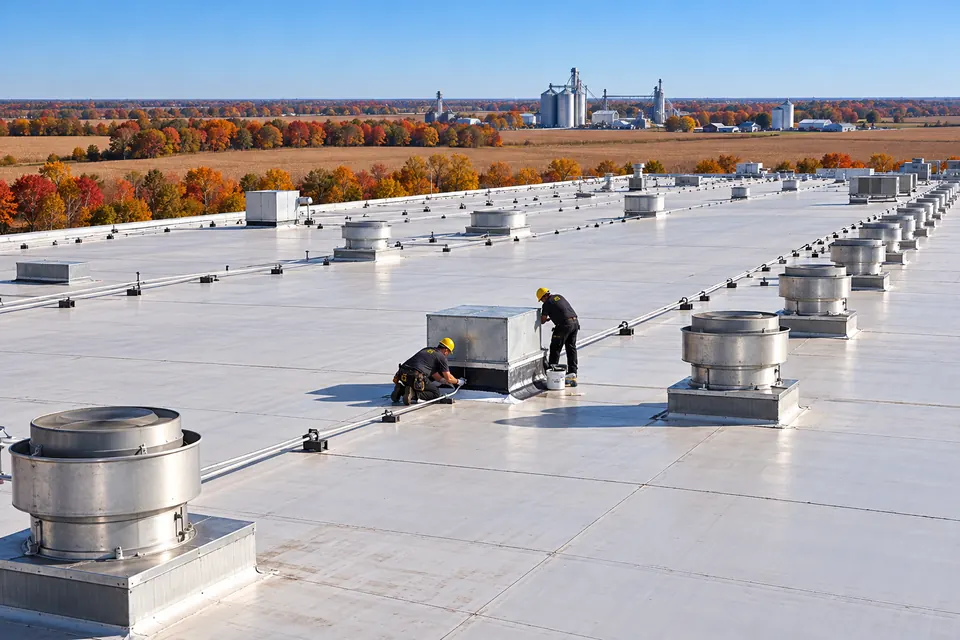
As a Hawesville commercial roofing contractor, we replace roofs on Hancock County buildings with rooftop units, planning electrical work alongside the membrane.

A Hawesville commercial roofing contractor plans the electrical side of a reroof early. Hancock County’s HBC sheet sends electrical inspection to the judge-executive’s office or the city office, based on the address, so the right office is settled before the electrician and roofing crew are booked.
Building inspection in Hancock County runs through the state building inspector. Hawesville is the county seat, so both offices are in town.
Roofs with electrical gear on them leak in a few repeat spots.
Runs laid straight on the roof trap water and debris and rub through the sheet as they move.
Conduit is lifted onto supports with pads, so the membrane passes beneath it untouched.
Boxes fastened near the roof surface leave no room for flashing to turn up behind them.
Your electrician moves the disconnect up while the roofing crew flashes the curb at full height.
Penetrations for power and control wiring were sealed with caulk that has dried and split.
Each penetration gets a proper boot or sealed junction box at the new roof level.
Condensate lines and loose curb flashing have dripped into the roof for years beside each unit.
Core cuts around the curbs size the wet area, and those boards are replaced during the reroof.
Sorting out the wiring at reroof time avoids opening the new membrane later.
Electrical work done after the membrane is laid means cutting and patching brand-new flashing.
Disconnects and conduit move before flashing, so the new roof stays intact.
Membrane that cannot reach full height behind a disconnect leaks during heavy rain.
Raised boxes leave space for full-height flashing on every side of the curb.
Pipes and conduit on the roof surface move with heat and grind into the membrane.
Supports with pads keep conduit off the sheet for the life of the roof.
Unplanned shutdowns leave rooms without heat or cooling while trades wait on each other.
Shutdowns are scheduled by zone, with the electrician and roofing crew on the same plan.
Which roof fits depends on how many units sit on it and how the building is used.
Welded TPO flashing at every curb and penetration, with walkway pads to each unit’s service panel.
Hancock County plants with fans, vents, and pipe racks get an industrial roofing plan matched to the exposure.
Dry roofs with leaks only at units can get repairs at the curbs and wiring penetrations.
Leaks at units usually trace to curb flashing, condensate lines, or a wiring penetration. Call and tell us which unit, and we will start there.
Electrical and roofing work interlock in this order.
Every unit, disconnect, conduit run, and penetration is photographed, and core cuts around the curbs show how far moisture spread.
The building address decides whether electrical inspection runs through the judge-executive’s office or the city office; building review goes to the state inspector.
Your electrician moves disconnects and lifts conduit onto supports while units are off and curbs are open.
Curbs are built up for the new insulation, and the membrane is flashed up each curb and around each penetration.
Units are reconnected, junction boxes are resealed at the new roof level, and walkway pads go in before the section closes.
We cover Hawesville and the towns below for commercial roofing. Is your building farther out? Go ahead and call us or send us a message.
Hancock County’s HBC contact sheet sends electrical inspection to the judge-executive’s office or the city office, depending on where the building sits. Hawesville is the county seat, so both offices are in town.
Building inspection runs through the state building inspector. Settle which office has the address before booking trades.
Your electrician. The roofing crew works around the finished electrical: once the disconnect is raised and conduit is on supports, the membrane is flashed up the curb and around each penetration.
Only while their section is open and the curb is being raised. Shutdowns are scheduled by zone, and units over occupied rooms are planned around business hours you set before work starts.
Matching the timing saves cutting new curbs twice. If a unit is due within a few years, setting the new curb during the reroof means the replacement unit drops onto a finished, flashed curb later.
Pitch pans dry out and pull away from what they surround. During the reroof they are sealed properly or replaced with boots or sealed boxes, depending on what passes through them.
Short runs on proper supports are fine, as long as the membrane passes freely underneath. Conduit lying directly on the sheet, even with padding, traps water and debris and wears through the membrane as it expands and contracts.
They do. Hatch and skylight curbs are raised to the new roof height when needed, and their flashing is replaced with the membrane, since an old curb detail at a hatch leaks just like one at a rooftop unit.
Tell us how many units sit on the roof and where it leaks. We will plan the roofing and electrical steps and send a free estimate.
Want a call back about your roof?
Leave a name and number and we will call you, or call (270) 249-4493 now.