

Targeted Repair
- Best When
- Leaks come from a few seams or flashings
- Insulation
- Dry in core cuts
- Work Area
- Single sections of the roof
- Disruption
- Small crew, light staging
- Watch For
- Repeat leaks at the same drains
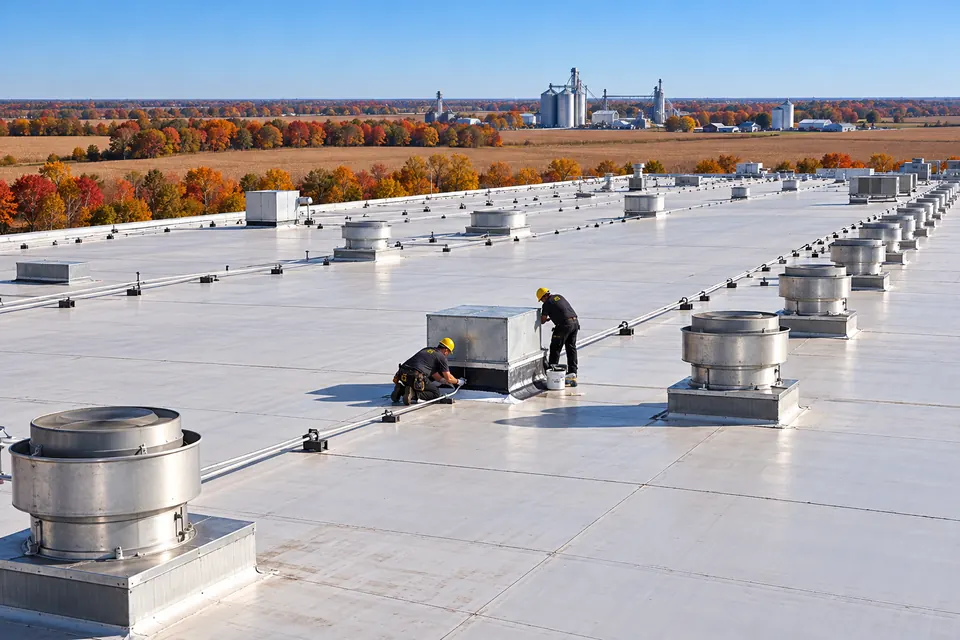
As an Owensboro commercial roofing contractor, we repair leaks and install TPO, EPDM, flat, and metal roofs on commercial buildings across Daviess County.
Most calls to an Owensboro commercial roofing contractor start with something seen from inside or from a ladder. Here is what each sign tends to mean up top.
Water is running along the deck from an open seam or a tired drain ring, then dropping where the deck has a low spot.
We match each stain to its spot on the roof, probe the seams above it, and take a core cut to see how far the insulation is wet.
Flat decks with sagging joists, clogged strainers, or too few outlets hold water near drains and low corners.
We clear the drains, mark every low spot, and price tapered insulation, crickets, or added outlets so water leaves the membrane.
Older single-ply sheets shrink with age and tug on their flashings until the corners split.
Short runs get new flashing and a heat-welded or taped patch; widespread shrinkage points us toward a recover or a new membrane.
Backed-out screws, dried washers, or an open end lap let water ride down the panel to the eave.
We drive larger screws with new washers into the purlin, clean and re-seal laps with butyl tape, and add stitch screws.
Wind pulls hardest at corners and perimeters, so loose cleats and short fastener rows let edge metal peel.
We refasten or replace the edge metal and coping, then check the membrane underneath for tears before closing it up.
Each problem below has a matching fix built into a replacement or a planned repair.
Soaked boards hold water against the steel deck, rust it from the top, and lose most of their insulating value.
Wet boards come out, the deck gets repaired where it is soft, and dry polyiso plus a cover board go down under the new sheet.
Standing water loads the deck, wears seams faster, and freezes into ice sheets on cold Kentucky nights.
Tapered insulation and crickets build slope toward the drains, and new drain rings and strainers clamp the membrane tight.
Added insulation raises the roof surface, so old curbs leave too little height for the flashing to turn up.
Curbs get raised, pipes go on supports with pads, and every penetration is flashed with the membrane maker’s parts.
Water gets behind caps and drip edge, soaks the wall, and runs down inside the building at the perimeter.
New edge metal and parapet caps are set at the new roof height with the membrane terminated underneath them.
Most commercial roofs fit one of three paths. The roof walk and moisture readings decide which one, and some buildings use two paths on different sections.
Leaks trace back to a few seams, fasteners, or flashings on a roof that is mostly dry.
Signs You Are Here
A new membrane goes over the existing roof once wet areas are cut out and the layer count allows it.
Signs You Are Here
The old roof comes off to the deck so every layer, flashing, and edge detail is rebuilt.
Signs You Are Here
Call and tell us which bay is wet and roughly where the nearest roof drain sits. That gets the first look aimed at the right seam.
Five decisions run in this order on every roof, from the first walk to the day the crane leaves.
We walk the field, edges, and every penetration, photograph seams and drains, and take core cuts where stains or soft spots point to wet insulation.
Moisture readings and the number of existing layers settle the call. A dry roof with local damage gets repaired; widespread wet boards mean a recover or tear-off.
Slope, grease exposure, foot traffic, and deck type narrow the choice to TPO, EPDM, PVC near exhaust fans, or metal panels on pitched buildings.
Crane picks, dumpsters, and debris chutes are placed away from loading docks and entrances, and rooftop unit shutdowns are planned by zone.
Crews remove only what they can cover before quitting time and seal every open edge with a tie-in so rain stays out overnight.
Two common answers for an older low-slope roof, side by side.
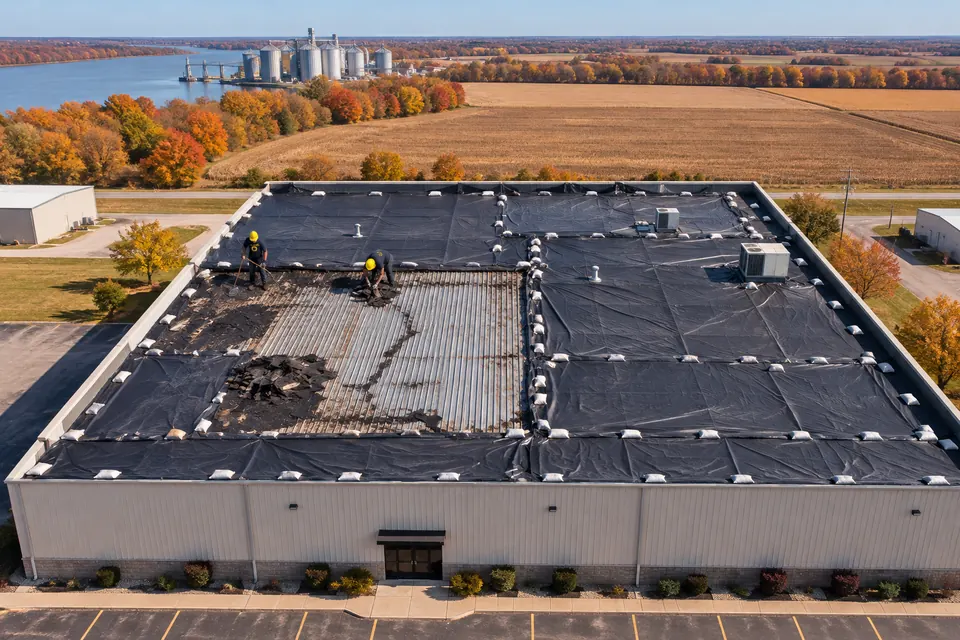
Plenty of Owensboro buildings land in between: a repair now on the dry half, with replacement of the wet half planned around the next budget.
Is your building near Owensboro? We handle commercial roofing across the towns below; for anywhere else, call us or send us a message.
Counties from the Kentucky HBC county contact sheets; distance computed from Wikipedia town-center coordinates (Owensboro to Central City).
Roof size, the system chosen, how much old roof comes off, and the number of rooftop details set most of the price. Two buildings with the same square footage can land far apart once drains, curbs, and edge metal are counted.
Tear-off of extra layers, wet boards found during removal, energy-code insulation, crane access, and roof height all move the number. A measured roof walk with core cuts is the only solid basis for a figure.
Every layer from the deck up. Crews check the steel, wood, or concrete deck, lay polyiso insulation (often tapered toward drains), add a firm cover board, then the TPO, EPDM, or other membrane, and finish with flashing at curbs, parapet caps, drains, scuppers, and edge metal.
OMPC, the Owensboro planning commission, handles building permits, plan review, and inspections for Owensboro and Daviess County, except inside Whitesville. Ask OMPC early how a replacement will be reviewed, especially when the scope includes deck replacement, new rooftop units, or drain changes.
Yes, in most cases. Sections are opened and closed in the same work shift, dumpsters and chutes are kept clear of entrances and docks, and rooftop units over occupied rooms are shut down on a schedule you agree to before work starts.
Single-ply membranes on flat and low-slope decks (TPO and EPDM, with PVC near grease), and standing seam or R-panel metal roofs on pitched shops and warehouses. Plant roofs with chemical or heat exposure get a membrane matched to that exposure.
Tell us the building, the roof type if you know it, and where water shows up inside. We will set up a roof walk and a free estimate.
Want a call back about your roof?
Leave a name and number and we will call you, or call (270) 249-4493 now.